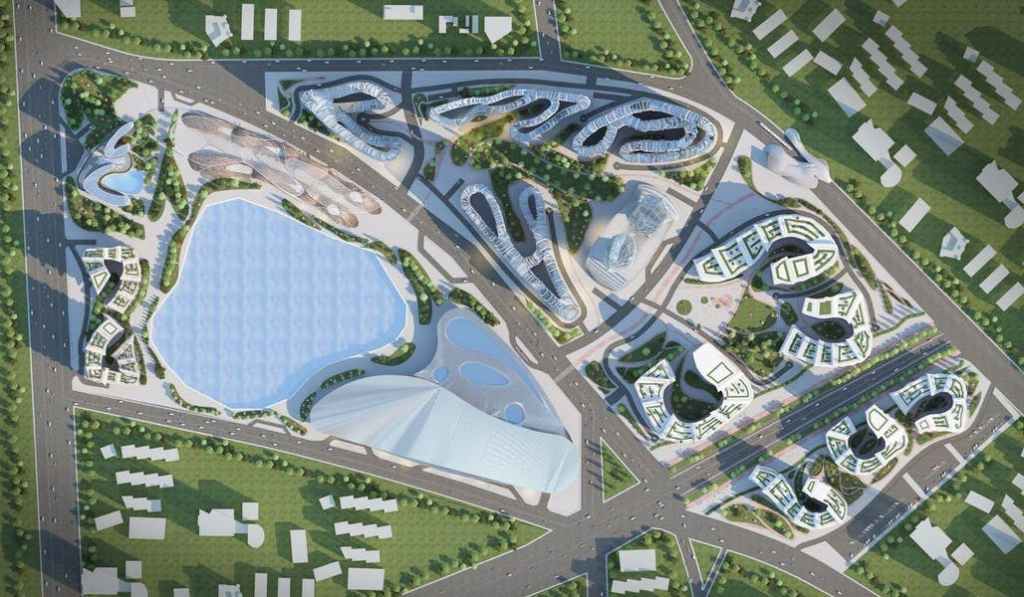

Akon, the Senegalese-American musician and entrepreneur, once captivated global headlines with his bold vision to build a futuristic, $6 billion smart city in his ancestral homeland of Senegal. Marketed as a high-tech utopia powered entirely by renewable energy and utilizing its own cryptocurrency, “Akon City” promised to transform the region by blending innovation with economic opportunity. Years after its grand announcement, however, the ambitious project appears to have stalled, with reports indicating that the city has been largely abandoned.
When Akon unveiled the concept in 2020, the idea was met with both excitement and skepticism. Drawing inspiration from movies like Black Panther, the artist imagined a cutting-edge metropolis complete with skyscrapers, luxury resorts, a tech hub, and sustainable infrastructure. The city was intended to run on Akoin, a cryptocurrency designed to empower African economies. At the time, Akon described the project as a way to provide jobs, stimulate growth, and offer a symbol of African progress.
The intended spot for Akon City was a 2,000-acre area situated on the Atlantic seaboard, close to the Senegalese village of Mbodiène. According to reports, the Senegalese government contributed the land, perceiving the initiative as a chance to enhance tourism, attract investments, and promote growth. Akon stated he had obtained financial backing from private investors and anticipated that the initial stage of development—comprising infrastructure, residences, and a police department—would be finished by 2023.
Nevertheless, as time went by, there was minimal physical advancement visible on the location. Reporters and community members who have been to the area have portrayed the land as mostly unchanged, with merely a modest sign indicating the prospective spot for the city. It has been reported that no significant building activities have occurred, and several of the bold commitments are still unachieved.
For those residing close to the planned project, the lack of advancement has led to skepticism and disappointment. Many had expected new employment prospects, infrastructure improvements, and advantages fueled by tourism. However, they remain in communities with restricted access to essential services, as the vision of Akon City appears to be becoming more unattainable.
The absence of noticeable progress has led to speculation about whether the project was ever financially feasible or overly ambitious from the start. Significant urban initiatives necessitate considerable, continuous funding and coordination—especially in areas where infrastructure remains under development. Certain analysts have highlighted the difficulties of initiating such a sophisticated city in a place lacking the essential groundwork.
Akon, on his part, has continued to affirm in interviews that the initiative is still ongoing, pointing to the COVID-19 pandemic and economic disturbances as major causes of its slow progress. He has stressed that constructing a city from the ground up is a complicated, lengthy task that necessitates thorough planning and resource management. However, despite these assurances, public confidence in the venture seems to have diminished as the anticipated advancements remain invisible.
The overarching concept of Akon City—centered around the use of blockchain technology, sustainable energy, and modern design to uplift African communities—struck a chord with many who envisioned significant transformation across the continent. Africa hosts some of the world’s rapidly expanding economies and has youthful demographics eager for advancement. Akon’s ambition matched a broader story of local solutions and contemporary African achievements.
Nonetheless, the practical execution of such visionary projects has proven to be a different matter altogether. Akon City is not the first high-profile development to face setbacks on the continent. Numerous proposed smart cities across Africa, from Kenya’s Konza Technopolis to Nigeria’s Eko Atlantic, have similarly encountered delays, funding issues, or reduced scope compared to initial promises.
El desfase entre ideales visionarios y realidades prácticas enfatiza los retos de ejecutar megaproyectos en economías emergentes. Problemas tales como la propiedad de tierras, financiamiento, asociaciones con el gobierno y obstáculos regulatorios pueden complicar incluso los planes mejor intencionados. Además, la mera magnitud de construir una ciudad futurista desde cero plantea desafíos logísticos que son difíciles de superar sin un apoyo considerable y constante.
For numerous people in Senegal, Akon City serves as a warning about ambitious pledges that don’t come to fruition. Although the musician’s desire to support his country and play a part in Africa’s future growth is well recognized, the absence of concrete advancements has caused disappointment among many.
The situation has also prompted broader conversations about how development should occur in Africa. Critics argue that large-scale, top-down projects often divert attention from more immediate, community-based solutions that could have a more direct impact on people’s lives. Rather than focusing on high-profile, expensive cityscapes, some advocate for investments in education, healthcare, small businesses, and existing urban centers.
Akon’s high-profile involvement brought international attention to the idea of African-led innovation and the potential for economic growth on the continent. Regardless of whether Akon City ultimately comes to fruition, the discourse it sparked about Africa’s future, technology’s role, and the importance of infrastructure and investment remains significant.
Currently, the proposed location is mostly vacant, and the schedule for building it is uncertain. Proponents of the initiative continue to believe the vision can be renewed, whereas critics regard it as yet another instance of unfulfilled promises without the ability to execute.
The story of Akon City serves as a reflection of both the aspirations and the complexities of development in Africa. It underscores the importance of balancing visionary ideas with practical execution and ensuring that communities who stand to be affected by such projects are not left waiting indefinitely for change that may never come.
Although the future of Akon’s visionary metropolis is still unclear, its impact might be more in the discussions it initiated about how African countries can utilize innovation, technology, and entrepreneurship to determine their futures independently.